
Why Real Will Always Be Premium
Articles
By G. Moore ·
AI is making video almost free. A polished feed isn't proof of anything anymore. Here's what still is — and why reputable brands are about to value it more, not less.
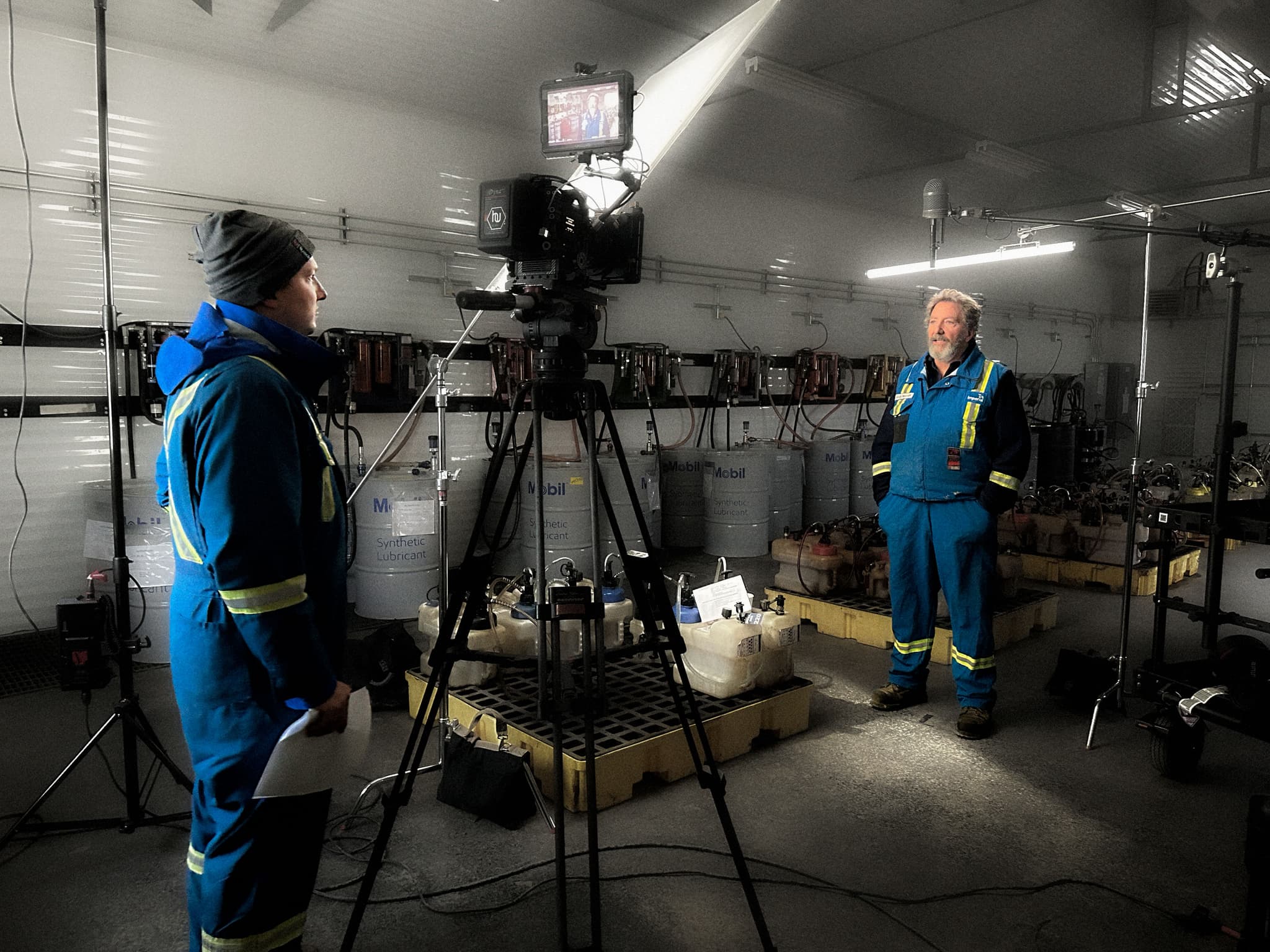
A 400-ton autonomous mining truck. Kearl Oil Sands, northern Alberta. Two days of travel to get there. Daily pre-dawn commutes once we did. A real operator on a real shift, describing how Mobil's fill-for-life lubricants keep the heaviest machinery on earth running through dust, cold, and 24-hour cycles where downtime costs millions.
We filmed it. His name was on the screen. So was the site. So was the company that trusted us enough to put a crew on the floor.
That's not a video. That's proof.
Cost Was Always the Signal
Film was a luxury. Scarce. Expensive. Hard to make. What the film said barely mattered — having one said it all. You could afford to shoot it. You were worth shooting. The cost was the proof.
Then digital made it cheaper and cheaper. Eventually a video only proved you owned an iPhone and a laptop.
AI is making it almost free. Now a video only proves you own a subscription.
A polished feed isn't proof anymore. Not of capital. Not of capability. Not of you.
The Same Pattern, Everywhere It's Already Played Out
Photography after Photoshop. Music after GarageBand. Design after Canva. The commodity got cheaper. The thing the technology fundamentally couldn't replicate became the premium. A hand-lettered sign at a fine restaurant signals craft because Canva exists. The restaurant could have used the template. It chose not to.
Video is in the same moment now — except the line between what AI can replicate and what it structurally cannot is sharper here than in any of those examples.
Two Categories, Not One Choice
There are two kinds of branded video, and they're now in different categories.
The first is ads, social, kinetic content. Stylized brand visuals. Product demos that don't pretend to document anything. AI is going to dominate this category. The economics are brutal, the velocity matters, and the buyer expects polish. Don't fight there. AI belongs there.
The second is documentary. Your real people. Your real operations. Your real work, captured on location by a crew that actually went there. This is the category that closes B2B deals, builds reputation, and survives quarterly content cycles. It is structurally outside AI's reach.
The choice for a reputable brand isn't "should we use AI for our documentary work?" That isn't a real question. No serious company is going to fabricate footage of their own people doing work they don't actually do.
The real question is how a marketing budget gets split between the two categories. That's where the argument starts.
What Happens When AI Becomes Wallpaper
Here's the part most of this conversation is missing: AI video is going to flood every feed within the next 24 months. The same platforms, the same lighting, the same camera moves, the same look. Once a stimulus is everywhere, the eye learns to skip it. AI footage will become wallpaper.
Real footage — operators with names, locations with weather, work with consequences — will read as anomalous against that wallpaper. Anomalous captures attention. Vinyl outlasted digital music. Film cameras came back after digital. Handmade exploded after Amazon. The pattern is consistent: when a technology democratizes a category, the real version becomes scarce, and scarce gets noticed.
Your reel of real shoots isn't just more credible than synthetic alternatives. In the saturation that's coming, it's going to outperform on attention itself.
The full argument — behavioral economics, historical precedents, what this means for a 24-month content plan — is in When AI Becomes Wallpaper.
Evidence vs. Illustration
Documentary-style brand video makes a claim that cannot be faked: we are who we say we are. The content is the proof. There is no shortcut.
You cannot generate the journey to Kearl Oil Sands. You cannot synthesize the operator's name on screen. You cannot simulate the company that trusted a crew enough to put it on a working floor.
The reason this category is structurally immune to AI is that witnessing cannot be generated. The whole point of documentary content is that the people, the place, and the work are real. The moment any of that content is synthetic, the claim collapses — not because the viewer can prove it, but because the production becomes a fraud the brand is committing against itself.
Documentary doesn't illustrate your operation. It witnesses it.
Asset Spend, Not Ad Spend
Here's the temptation that is real: $5K of AI-generated brand video looks decent on a phone screen. $75K of documentary feels like fifteen times the spend. The math seems obvious — choose the cheap option.
That isn't math. It's a category error.
Documentary spend isn't ad spend. It's foundational brand asset spend — and the comparison shouldn't be to a six-week ad campaign. It should be to the cost of the materials you'll use across every campaign you run for the next two years.
We don't run your media buy. We don't manage your funnel. We're not the campaign. We deliver the materials that fuel everything you and your agency will run — long-form films, social cuts, paid ad versions, brand photography, testimonial clips, B-roll for future edits. A single Series engagement is 30+ deliverables from three shoots. Compare a $75K Series to the per-asset cost — what each individual deliverable would have cost as a one-off — and the math inverts. Compare it to the durability of the assets across multiple campaigns and multiple quarters, and it inverts again.
The cost is the point. Skin in the game. Proof of stake. The price gap between an AI ad and a documentary Series isn't a problem to solve — it's the message itself.
The full asset-vs-campaign economics — cost-per-deliverable, durability across quarters, where this fits in a CFO conversation — is in The ROI of Documentary: Series Spend Isn't Campaign Spend.
The Moat Is the Message
For twenty years, the barrier to documentary-style brand video was budget. AI just handed every brand a $5K alternative — for the categories where AI belongs. Which means your allocation — funding the documentary job at the documentary price — is louder, clearer, and more defensible than it has ever been.
Look at who's actually doing it. SpaceX is shipping long-form documentary content for Starship — even while Elon's other company, xAI, makes Grok Imagine, one of the leading AI video tools. The man who literally owns the AI is filming the rocket. NFL Films, F1's Drive to Survive, Patagonia's environmental work, Apple's product films — every brand with a real story to tell is doubling down on documentary as AI floods the cheap category. They're not the exception. They're the pattern. Companies with real stories worth telling double down. Companies without real stories pivot to AI.
The full leader pattern — what every premium documentary brand is doing right now and what it tells you about your own content roadmap — is in Even Elon Films the Rocket.
What still proves it: your real people. Your real operation. Your real work — filmed, on location, by a crew that flew there.
If your work is worth filming, film it. If your people are worth knowing, show them. If your operation is the kind serious buyers take seriously, let a crew in.
AI makes video. We make proof.
See What a Series Engagement Actually Looks Like
Digging Deeper — five days in northern Alberta. Two hero films, a B-roll package, 30 still images, eight social spots.
Hardworking Fuel — seven states, sub-zero BC, Texas ranches, Chicago school buses. Seven hero videos, a sizzle reel, an MLB stadium spot, and a footage library.
Three shoots. Thirty-plus deliverables. Real people, real locations, ready for the page or the procurement deck.